
Equine lameness is a change in the way a horse moves or stands. It can stem from pain, restricted movement or an underlying neurological issue, and it is almost always a sign of something deeper.
For trainers, lameness sits at the centre of the operation. It shows up as missed gallops, days out of work, disrupted competition seasons and racing campaigns and owners asking when their horse will be back in work. Over time, it affects recovery windows, owner confidence and how long a horse stays competitive.
The trainers who protect long-term soundness are the ones who catch the small changes before they become big ones. This guide walks through how a lameness episode typically unfolds: noticing the first signs, working through diagnosis with your vet, understanding what has been found, weighing treatment options, and managing the return to work.
Key takeaways
- Subtle changes in stride, behaviour or recovery are often the earliest signs of lameness worth flagging to your vet.
- Diagnosis of the cause is often the veterinarian’s role, but trainers and riders are usually the first to notice that something has changed.
- Joint-related lameness frequently develops through repeated loading rather than one obvious incident.
- Treatment options for joint-related lameness range from anti-inflammatory approaches through to intra-articular treatments targeting different parts of the joint environment.
- Return to work decisions should be made with the vet and matched to the underlying cause.
Stage 1: Noticing the first signs
Early signs of lameness are often subtle. A shortened stride, loss of fluency, reluctance to work, unevenness on turns, stiffness after exercise, slower recovery between sessions, or a change in attitude.
Some signs are more obvious. Heat or swelling in a limb. Sensitivity to palpation. A horse that is clearly favouring a leg. Others are harder to pin down. A horse that is “not quite right”. A horse with reduced willingness to work. A horse that takes longer to warm up than it used to.
Not every change means a serious injury. But repeated or persistent changes should not be ignored. Subtle, ongoing signs are often how joint stress, soft tissue strain or early joint disease first appear. Catching them early gives more treatment options and usually means less disruption to the training programme long-term.
The trainers who get the best outcomes tend to do two things consistently:
- They notice early. They know each horse’s normal and they pick up on shifts in behaviour, work quality, recovery or stride.
- They flag early. They call the vet before a subtle change becomes a clear lameness, rather than waiting to see if it resolves.
Stage 2: Getting it diagnosed
Once the vet is involved, the diagnostic process moves through a series of steps. Understanding what each one is doing helps trainers brief the vet well and stay engaged in the case.
History and clinical examination
The vet will usually start with questions about the horse’s age, workload, recent training changes, shoeing history, prior injuries, and what the trainer has been noticing and when. The more specific the trainer can be, the more useful the conversation. “Off on the right rein for about ten days, worse on hard ground, better after warming up” is more useful than “not quite right”.
The clinical exam typically includes palpation of limbs, joints and back, assessment of conformation, and looking for heat, swelling, pain on flexion or asymmetry.
Gait assessment
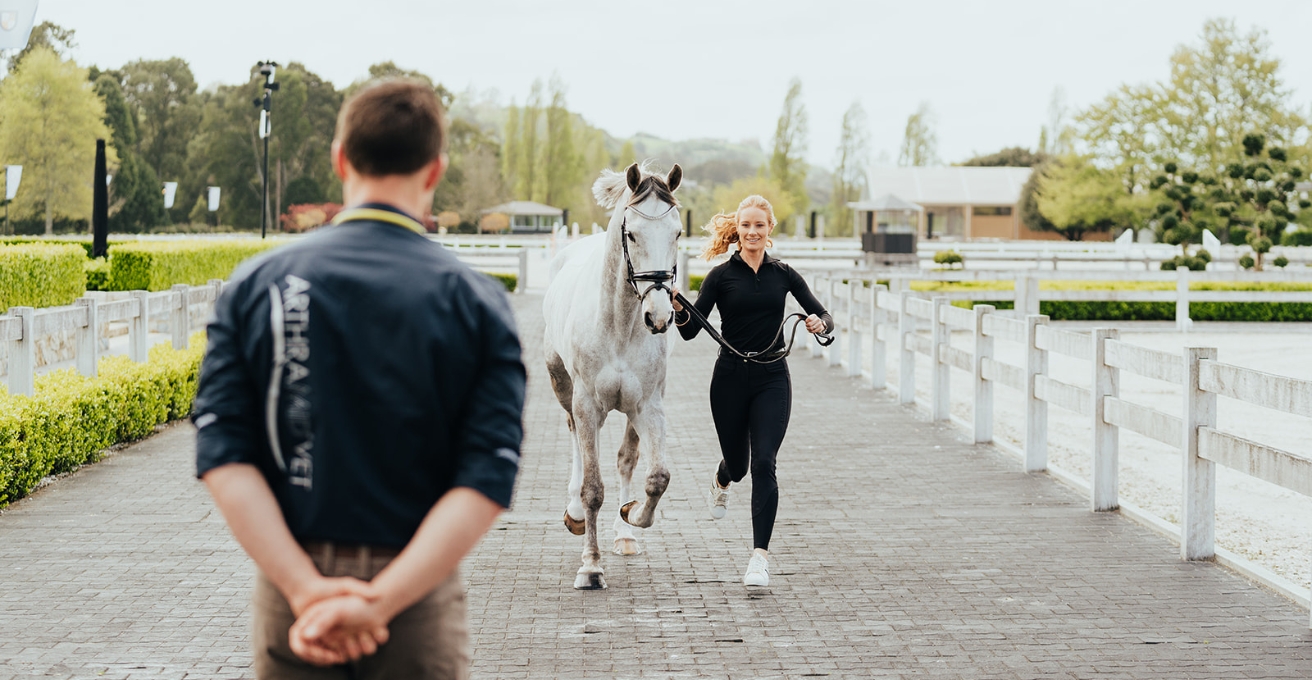
The vet will watch the horse move at walk and trot in hand, often on different surfaces and on the lunge. They are looking for the head nod that signals forelimb lameness, the pelvic rise that signals hindlimb lameness, changes in stride length, and how the lameness behaves on different rein directions and surfaces.
Flexion tests
A joint is held in flexion for a short period, then the horse is trotted off and watched for any worsening of the lameness. Flexion tests are not perfectly specific, but they help the vet narrow down which area to focus on.
Regional analgesia (nerve and joint blocks)
This is where diagnosis often becomes precise. The vet anaesthetises a specific region of the limb or a specific joint, then watches the horse move again. If the lameness improves significantly, the source of pain is in or below the blocked area. Blocks are worked methodically from the bottom of the limb upwards.
For trainers, this stage can take time. Blocks are not always definitive on the first try, and the vet may need to repeat the process across multiple visits. That is normal.
Imaging
Once the area has been localised, imaging confirms what is going on inside the joint or soft tissue. Radiographs show bony changes. Ultrasound shows tendon and ligament structure. MRI and CT give more detailed three-dimensional information and are increasingly used in performance horse work, particularly for foot-related lameness and complex cases.
Imaging is interpreted alongside the clinical findings. A horse can have changes on radiographs that are not causing the current lameness, and a horse can have significant pain with very little to see on imaging.
Stage 3: Understanding what your vet has found
Once the workup is complete, the vet will explain what they have found. Lameness is a sign, not a diagnosis, so the conversation should move from “the horse is lame” to “here is what is driving it”.
The main categories trainers will hear about are:
Joint-related lameness. Often linked to synovitis, osteoarthritis, repetitive loading or acute joint trauma. Common in performance horses and often develops gradually. Osteoarthritis alone is estimated to account for around 60% of lameness cases, and one study of the equine industry found that as many as 75% of thoroughbreds showed signs of lameness.
Soft tissue lameness. Injuries to tendons or ligaments, particularly the deep digital flexor tendon and suspensory ligament apparatus. These can become chronic and may threaten a horse’s career if not managed well.
Foot and hoof-related lameness. Forelimb lameness is especially common, and almost 95% of forelimb cases originate from the carpus down, often involving the hoof capsule, lower limb joints or structures affected by shoeing balance, conformation or track conditions.
Mechanical lameness. Physical restriction of movement that may not be driven by pain. Examples include upward fixation of the patella or structural issues.
Neurological lameness. Driven by neurological dysfunction rather than pain. Signs may include stumbling, weakness or inconsistent limb placement.
The category matters because it shapes everything that follows: treatment options, recovery timeline, return to work, and long-term outlook.
Stage 4: Weighing treatment options
For joint-related lameness specifically, treatment options sit on a spectrum from systemic to local, and from short-term symptom management to longer-term joint support.
Systemic anti-inflammatory medication
Non-steroidal anti-inflammatory drugs such as phenylbutazone (Bute) are commonly used for short-term pain management. They can help a horse feel better but do not address the underlying joint changes. They are often part of a broader treatment plan rather than the whole plan.
Intra-articular corticosteroids
Steroids injected directly into the joint reduce inflammation locally. They have been a mainstay of joint management for decades, work quickly, and are well understood by vets. The trade-off is duration of effect and questions around repeated use in some joints over time.
Hyaluronic acid (HA)
HA supports joint lubrication and can be administered intra-articularly or systemically. Often used in combination with other treatments.
Biologics
Treatments such as IRAP, PRP and stem cell therapy use the horse’s own biological material to support joint function and tissue repair. These are typically more expensive, often used in specific case profiles, and require careful case selection.
Injectable polyacrylamide hydrogel (iPAAG)
A more recent option in equine joint treatment. iPAAG is implanted into the joint and integrates with the synovial membrane, the tissue lining the joint. Recent biomechanical analysis has shown that in experimentally induced osteoarthritis, the synovial membrane can become significantly stiffer than healthy tissue, and iPAAG is designed to support the joint environment over the longer term rather than only manage symptoms in the short term. Arthramid is a 2.5% iPAAG product administered by veterinarians as part of a diagnosis-led treatment plan.
Questions worth asking your vet
Treatment conversations go better when trainers ask specific questions. Useful ones include:
- What is the treatment designed to do, and over what timeframe?
- How does it fit into the wider plan for this horse?
- What does recovery and return to work look like?
- Are there options I should know about that you are not recommending in this case, and why not?
- The aim is not to second-guess the vet. It is to make sure both sides are clear on what is being treated, why, and what success looks like.
Stage 5: Returning to work
Returning a horse to training is where the trainer’s expertise comes back to the front of the process. The vet sets the clinical parameters. The trainer manages the day-to-day programme within them.
A few principles worth holding to:
- Match the return to the underlying cause. A horse that looked sound after a few weeks of rest may not actually be ready. Soft tissue injuries in particular often need a longer, more graduated return than they appear to need. Joint-related cases may have specific re-introduction protocols.
- Reintroduce work gradually. Building load incrementally gives the tissue time to adapt. Going back to full work too early is one of the most common reasons for recurrence.
- Monitor closely in the first weeks back. Pay attention to stride quality, recovery between sessions, attitude, and any return of the original signs. The horse that came back well in week one but feels different in week three is telling you something.
- Stay in contact with the vet. A check-in part-way through the return-to-work process is often more useful than waiting for a problem to reappear.
- Plan around the horse, not the calendar. Race or competition timelines matter, but a horse rushed back is a horse more likely to break down again or develop secondary issues.
