
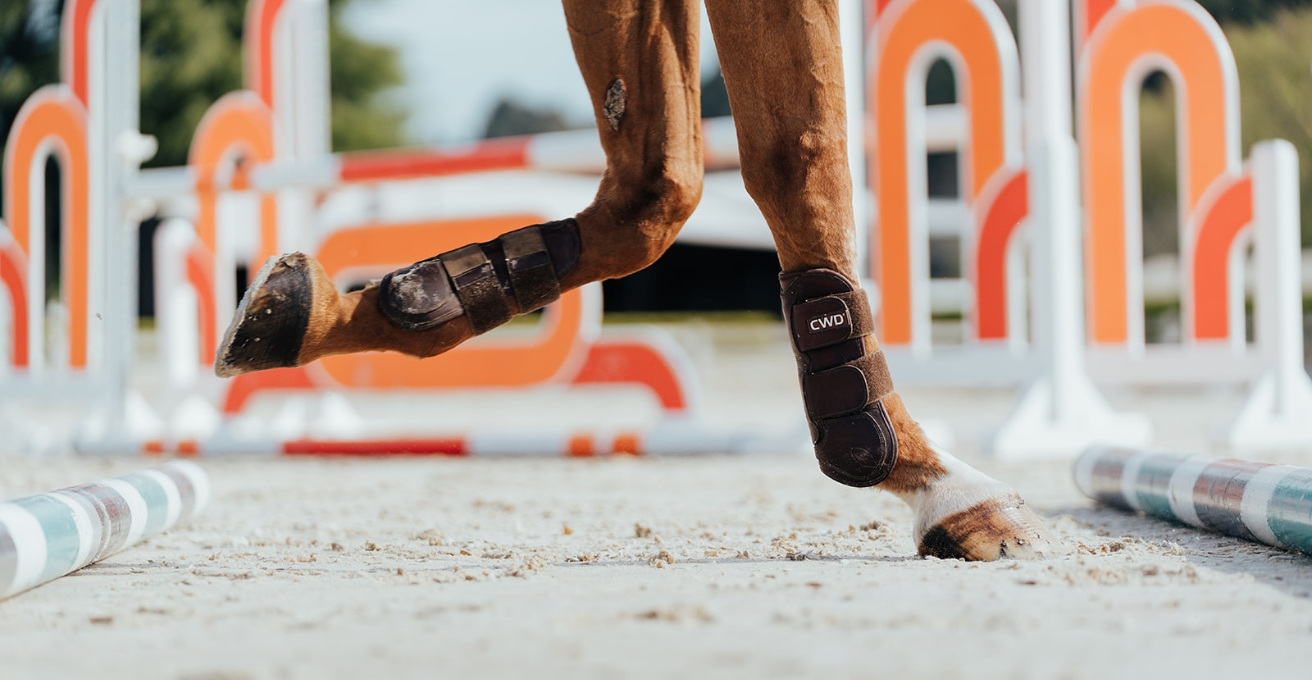
If your vet has raised joint injections for your horse, it helps to understand the options before the conversation goes further. The coffin, fetlock and hock are among the most commonly treated joints in performance horses. This guide covers what these joints are, how a problem shows up in the horse, the treatment choices available, and where 2.5% iPAAG fits, so you can make an informed decision alongside your vet.
Key Takeaways
- The coffin, fetlock and hock are worked hard in athletic horses, which is why they are common sites for the joint inflammation and osteoarthritis that lead to lameness.
- You are often the first to notice a problem. Subtle lameness, stiffness that eases with work, a shortened stride, or a drop in performance are the early signs worth acting on.
- Treatment options differ in how they work and how long they last. Corticosteroids and hyaluronic acid manage inflammation and lubrication. 2.5% iPAAG works at the joint lining and lasts longer from a single treatment.
- 2.5% iPAAG is non-pharmaceutical and carries no competition withhold time, which matters for horses in active work. Its effect builds over two to four weeks, so timing around competition is worth planning with your vet.
Why the Coffin, Fetlock and Hock Are Commonly Affected
These three joints sit low in the limb, carry high load, and take repeated strain in ridden and racing work. That combination makes them common sites for the inflammation and wear that lead to lameness.
Two terms are worth being clear on. Osteoarthritis (OA) is the progressive breakdown of a joint, usually driven by ongoing inflammation of the joint lining. Synovitis is inflammation of that lining, and it is often the earlier, more manageable stage of the same process. Catching a problem at the synovitis stage, before lasting change sets in, is one of the reasons early signs are worth taking seriously.
Each joint carries its own risk for a reason. The coffin joint sits inside the foot and bears the horse’s weight at the point of contact, so it is a frequent source of front-limb lameness. The fetlock moves through a large range under high load at speed. The hock is not one joint but four, and OA almost always affects the lower two, which is where the condition often called bone spavin develops.
Once you flag a concern, your vet pinpoints the joint responsible using flexion tests, nerve or joint blocks, and imaging such as radiographs. That step matters, because treating the right joint is what makes treatment work. Your role is to notice the change early and describe it well.
The Coffin Joint
What you may notice. Front-limb lameness is the usual sign, sometimes worse on a circle or on hard ground. Because the coffin joint sits within the foot, its problems can look similar to other foot issues, which is why your vet confirms it before treating.
Treatment options. Corticosteroids give fast relief from inflammation and are widely used, though repeated use carries considerations for the joint over time. Hyaluronic acid supports lubrication and is often used alongside other treatments. 2.5% iPAAG (Arthramid) works at the joint lining rather than as a drug, and suits horses where a longer-lasting, steroid-sparing option is preferred.
Where Arthramid fits. Arthramid is suitable for both early joint inflammation and later-stage osteoarthritis in the coffin joint. Two studies focused on this joint support its use. Janssen et al (2012) reported that 67% of treated coffin joints were sound again at six months in horses that had not responded to previous treatment, and Bathe et al (2016) reported 66% sound with a further 16% improved, again in horses that had not responded before. Because Arthramid’s effect builds over the first few weeks rather than acting immediately, it suits planned management rather than a last-minute fix.
The Fetlock Joint
What you may notice. Reduced stride length, a reluctance to push off, filling or heat around the fetlock, and a fall-off in performance at speed or over fences. In hard-working horses the change can be subtle before it becomes an obvious lameness.
Treatment options. Corticosteroids give reliable short-term control, with considerations for repeated use over time. Hyaluronic acid may support lubrication and eases inflammation. 2.5% iPAAG has evidence supporting its use in high-motion joints like the fetlock, where its longer duration from a single treatment reduces how often the horse needs re-treating.
Where Arthramid fits. The fetlock takes high load at speed, so durability matters. A single Arthramid treatment commonly provides an effect measured in months. Tnibar et al (2015) reported that 82.5% of treated horses were sound at both 12 and 24 months, which is well beyond what a corticosteroid interval typically offers. For a horse in active work, fewer treatments and a longer effect is a practical advantage.
Planning Around Competition
Two points matter most for competition horses. First, corticosteroids carry a competition withhold time that varies by jurisdiction and governing body, so they need to be planned around the calendar. Arthramid is not a prohibited substance and carries no competition withhold time. Second, because Arthramid’s effect develops over roughly two to four weeks, a treatment timed ahead of the season lets the benefit establish before the horse is in full work. Talk to your vet about timing early.
The Hock
What you may notice. Hind-limb stiffness that eases as the horse warms up, a shortened stride behind, resistance to work that loads the hocks such as collection or jumping, and a positive response when the hock is flexed. Owners and trainers often pick this up as a gradual loss of hind-end power rather than a clear limp.
What is affected. OA almost always affects the lower two hock joints, the low-motion joints where bone spavin develops. The upper, high-motion joint is rarely the problem, so treatment is directed at the lower two.
Treatment options and where Arthramid fits. Corticosteroids are well supported for the lower hock joints and remain a common choice for bone spavin. Hyaluronic acid is used alongside. Arthramid is an option for the lower hock joints where a longer-lasting treatment is preferred. The lower two hock joints are often affected together, and Arthramid can be used to treat more than one joint, with each assessed by your vet on its own merits. As with the other joints, timing ahead of the competition season allows the effect to establish before full work resumes.
Comparing the Treatment Options
Each option works differently, and the right one depends on the joint, the stage of the disease, and how your horse is used. This is a conversation to have with your vet, but the table below sets out the practical differences.
| Option | How it works | How soon it acts | How long it lasts | Competition withhold time | Best suited to |
| Corticosteroids | A drug that reduces inflammation | Fast, within days | Weeks to a few months | Yes, varies by jurisdiction and governing body | Acute flare-ups needing fast relief |
| Hyaluronic acid | Improves lubrication and eases inflammation | Days | Short, typically days | Check with your vet | Mild inflammation, often alongside another treatment |
| 2.5% iPAAG (Arthramid) | A hydrogel that integrates into the joint lining, restoring elasticity and improving the joint environment. Not a drug | Builds over 2 to 4 weeks | 6 to 12 months, and longer in some cases | None | Early and later-stage OA, repeat cases, and horses where a steroid-sparing option is preferred |
The point of difference with Arthramid is that it is not a drug. It is a hydrogel that becomes part of the joint lining, helping to restore the joint’s elasticity and improve the environment inside it, rather than acting through a medication effect that wears off. Research into how it integrates (Lowe, de Clifford et al, 2024) shows the gel becomes incorporated into the joint lining rather than being broken down or cleared, which is why a single treatment can last so much longer than a drug-based option.
Is It Safe, and What Should I Expect Afterwards?
Joint injection is a low-risk procedure carried out by your vet under careful conditions. It is worth understanding the safety picture so you know what is normal and when to call.
Arthramid’s safety record. The most common reaction, if any, is mild, short-lived swelling or tenderness at the site, reported in fewer than 1 in 2,500 treatments, and it settles on its own. Larger studies support this. A series of more than 1,000 sport horses found that most needed only a single treatment per joint during the competition season, with just 6.8% requiring a repeat in the same joint, and safety data on 701 Thoroughbred racehorses presented in 2025 supported its use for long-term joint management.
Serious complications are rare. Joint infection is the main serious risk with any joint injection, and it is uncommon. Your vet takes specific precautions to prevent it. Contact your vet promptly if you notice significant heat, swelling, increasing lameness, or your horse seems unwell in the days after any joint treatment.
After treatment. A short rest is usual, followed by a gradual, controlled return to work. Because Arthramid’s effect builds over the first two to four weeks, your horse comes back into full work gradually, guided by how they respond rather than a fixed date. Your vet will give you a plan for your horse.
Joint disease does not have to be the end of a horse’s working life. If you have noticed a change in your horse, the best next step is a conversation with your vet about what is going on and which treatment fits.
