
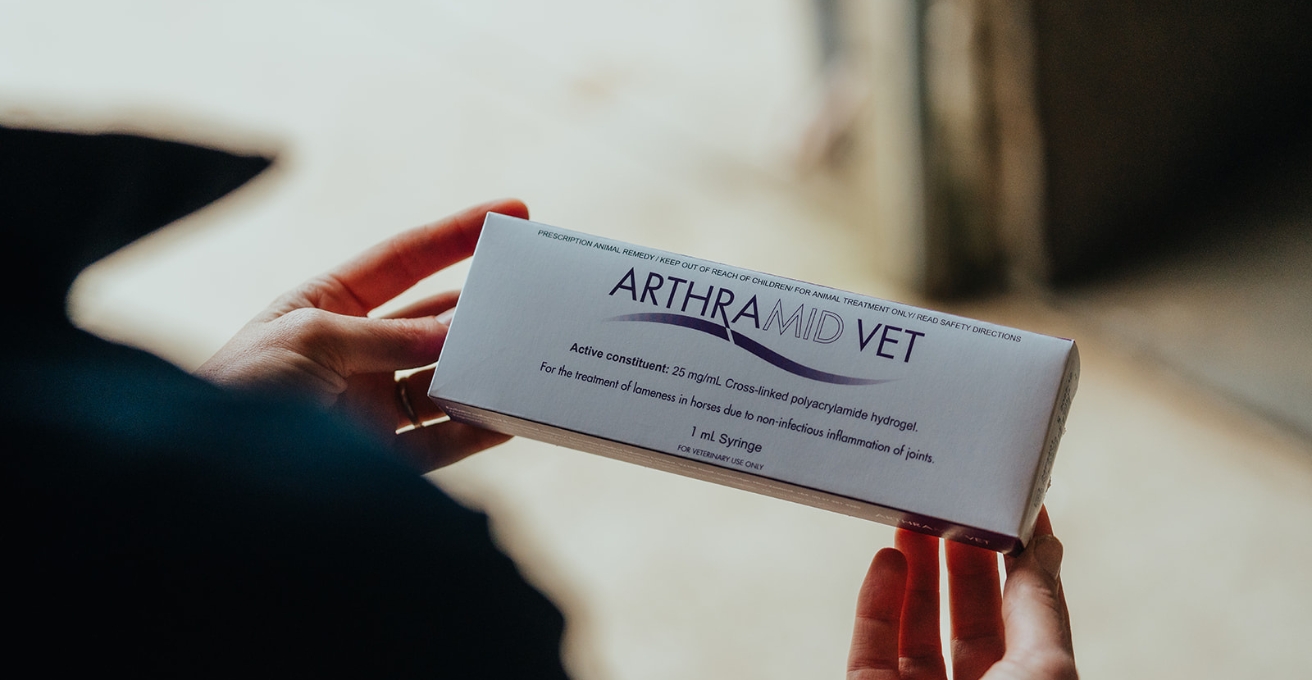
Intra-articular injection sits at the centre of how we manage equine osteoarthritis. For decades that has meant corticosteroids. The landscape has widened, and choosing between modalities now calls for active clinical reasoning rather than habit.
Key takeaways
- Corticosteroids and 2.5% injectable polyacrylamide hydrogel (2.5% iPAAG) work through fundamentally different mechanisms. That difference, not preference, should drive case selection.
- Corticosteroids give rapid, reliable, short to medium term control of synovial inflammation. Effect is usually measured in weeks to a few months, and repeat dosing is common.
- 2.5% iPAAG integrates into the synovial membrane and supports joint function over a longer horizon from a single injection. One multicentre study reported 82.5% of horses lame-free at 24 months (Tnibar et al 2015).
- In a double-blinded positive control study, 2.5% iPAAG resolved 83.3% of middle carpal lameness at 6 weeks, compared with 27.3% for triamcinolone acetonide and 40% for hyaluronic acid (de Clifford and Lowe 2021).
- The two approaches are not mutually exclusive. Both can sit within a multimodal OA plan, and concurrent use with a corticosteroid has been assessed (Whitaker et al 2025).
Corticosteroids have well-understood strengths and equally well-understood limits, particularly the cartilage and metabolic considerations that come with repeated use in certain cohorts. 2.5% iPAAG offers a mechanistically distinct option with a growing peer-reviewed evidence base. This article compares the two across mechanism, duration, clinical outcomes, safety and case selection, and looks at how they fit together in practice.
How do corticosteroids work as a joint injection in horses?
Intra-articular corticosteroids act by binding glucocorticoid receptors and suppressing the inflammatory cascade within the joint. The result is a reduction in synovial inflammation, effusion and pain. Onset is rapid, often within a few days, and the effect is finite.
The depot formulations most often used in equine practice are triamcinolone acetonide (TA) and methylprednisolone acetate (MPA), with betamethasone esters also used. Duration of effect ranges from a few weeks to a few months, depending on the agent, the joint, the dose and disease severity, and clinical benefit can outlast the point at which the drug is detectable in blood. Because the effect is time-limited, repeat injections are common in ongoing OA.
The cartilage picture is agent-dependent and worth holding accurately. Triamcinolone acetonide has been reported as chondroprotective at commonly used doses in equine osteochondral models, whereas methylprednisolone acetate has been associated with cartilage matrix changes, particularly at higher or repeated doses (Frisbie et al 1997). This nuance matters for long-term management planning rather than single, targeted use.
Corticosteroids remain appropriate and effective for acute synovitis, high-motion joints, targeted flare control, and pre-competition scenarios where an adequate stand-down window can be applied.
How does polyacrylamide hydrogel work in a horse’s joint?
2.5% iPAAG is a non-degradable, cross-linked polyacrylamide hydrogel comprising roughly 97.5% water and 2.5% polyacrylamide. Injected intra-articularly, it integrates into the synovial membrane, becoming incorporated into the subintima within about 14 days (Lowe et al 2024; Christensen et al 2016). Rather than acting as an anti-inflammatory drug, it restores synovial membrane elasticity and supports joint function, targeting synovitis, which is recognised as a primary driver of OA pain. It is not classified as a medication.
Tissue response has been characterised directly. Histology in normal equine joints showed a low-level, transient macrophage-driven foreign body response with normal cell counts and no fibrosis or granulomas (Lowe et al 2024). Emerging transcriptomic work in experimentally induced OA describes modulation of innate immune and inflammatory signalling within the synovium, including downregulation of inflammatory pathways in the weeks after injection (Pezzanite et al 2025; Chow et al 2026).
Onset is not instantaneous. Effect develops over days to weeks, with clinical improvement often seen within two to four weeks. The gel is highly biocompatible, which underpins its excellent safety profile across multiple species.
How do the two options compare clinically?
Both modalities produce meaningful lameness improvement. Corticosteroids offer faster onset. 2.5% iPAAG shows greater durability in long-term follow-up. The published comparative data illustrate the point:
- Double-blinded positive control (de Clifford and Lowe 2021): in middle carpal joint lameness in racing Thoroughbreds, 2.5% iPAAG resolved 83.3% of cases at 6 weeks, compared with 27.3% for triamcinolone acetonide and 40% for hyaluronic acid.
- Controlled clinical trial (Tnibar et al 2014): soundness of 55%, 65% and 75% at 1, 3 and 6 months for 2.5% iPAAG, versus 15%, 40% and 35% for a TA and HA group (p=0.001).
- International multicentre prospective study (Tnibar et al 2015): 82.5% of horses lame-free at 24 months after a single injection (n=43).
- Distal interphalangeal case series (Janssen et al 2012): 67% lame-free at 6 months.
Re-treatment patterns differ accordingly. Corticosteroids are commonly repeated across a season. With 2.5% iPAAG, a single treatment is often sufficient. A long-term retrospective of 701 Thoroughbreds reported a mean re-treatment interval of about 234 days where re-treatment was required (de Clifford et al 2025).
Corticosteroids and 2.5% iPAAG at a glance
| Factor | Corticosteroids | 2.5% iPAAG (Arthramid) |
| Mechanism | Anti-inflammatory. Glucocorticoid-receptor suppression of the inflammatory cascade. | Physical integration into the synovial membrane. Restores capsular elasticity and targets synovitis. |
| Onset | Rapid, often within days. | Gradual, over days to weeks. |
| Duration of effect | Weeks to a few months, agent and joint dependent. | Sustained. 82.5% lame-free at 24 months after a single injection in one study. |
| Re-treatment | Commonly repeated. | Single treatment. Mean interval about 234 days where re-treatment is needed (701-horse retrospective). |
| Cartilage considerations | Agent-dependent. TA and MPA associated with cartilage matrix changes at higher or repeated doses. | No cartilage degradation reported. A preclinical osteochondral model reported better cartilage scores in treated joints (Contino et al 2025). |
| Metabolic and laminitis risk | IA triamcinolone can transiently raise insulin. Caution in insulin-dysregulated and PPID horses given the laminitis association. | No systemic metabolic pathway. A consideration for older horses and those with metabolic comorbidities. |
| Competition stand-down (NZ and AU) | Detection and stand-down times apply and vary by agent and body (for example, FEI detection of roughly 7 days for TA and 28 days for MPA). | Non-pharmaceutical. No competition withhold time in New Zealand or Australia. |
| Evidence base | Long clinical history and extensive literature. | Growing peer-reviewed evidence to 24 months, plus histology, mechanism and retrospective data. |
Detection and stand-down times are illustrative and change over time. Confirm current requirements with the relevant racing or competition body before treating a horse in work.
What are the safety considerations for each option?
Both options carry distinct risk profiles, and understanding them is central to defensible case selection.
- Corticosteroids. The two main considerations are cartilage effects and metabolic risk. Cartilage impact is agent and dose dependent. Separately, intra-articular triamcinolone has been shown to raise resting insulin transiently, which is clinically relevant in insulin-dysregulated and PPID horses because of the association with laminitis (Bailey 2010). Systemic effects become more relevant with higher or repeated dosing. These points inform planning rather than ruling corticosteroids out.
- 2.5% iPAAG. The gel has been well tolerated across clinical studies. Histology showed only a normal low-level, transient macrophage response with no fibrosis or granulomas (Lowe et al 2024). A long-term Thoroughbred retrospective recorded an adverse event rate of 0.13% across 2,312 injections in 701 horses (de Clifford et al 2025). With no systemic metabolic pathway, it is a reasonable consideration for older horses and those with metabolic disorders.
Neither option replaces multimodal OA management. Each is a component decision within a wider plan.
Which cases suit corticosteroids, and which suit 2.5% iPAAG?
Case selection depends on disease chronicity, re-treatment history, metabolic status, competition schedule, and owner or trainer expectations around duration.
Corticosteroids may suit:
- Acute synovitis or an inflammatory flare
- Early-stage or single-episode presentations
- High-motion joints needing rapid control
- Pre-competition, with an adequate stand-down window
2.5% iPAAG may suit:
- Chronic OA
- Repeat-injection cases with diminishing returns
- Horses with metabolic comorbidities
- Performance horses where long-term soundness is the goal
- Cases where a single-treatment approach is preferred
The two are not mutually exclusive. Concurrent intra-articular use of 2.5% iPAAG and betamethasone esters was well tolerated with no adverse events in a study of 10 healthy horses (Whitaker et al 2025). Whether to combine them remains a clinical decision for the treating veterinarian.
How does Arthramid fit into an equine OA protocol?
Arthramid (2.5% iPAAG) is not a replacement for comprehensive OA management. It is a single-treatment, long-duration intra-articular option that integrates within a multimodal protocol, alongside NSAIDs, farriery, rehabilitation, and weight and dietary management where relevant.
In the New Zealand context, it is registered under the ACVM Act (No. A011596), is non-pharmaceutical, and carries no competition withhold time. Contura reports more than 300,000 horses treated worldwide, and New Zealand clinical data is available through the de Clifford work in Thoroughbred practice. The positioning here rests on the clinical data and case selection criteria rather than promotion.
For use only by a veterinarian. Clinical decisions rest with the treating veterinarian based on the individual patient.
Find out more
Clinical resources for your OA cases. Access mechanism detail, dosing guidance and case selection support to inform your protocol decisions. Visit the equine vets page: https://arthramid.com/nz/equine-vets/
Managing metabolically complex cases? Read the PPID and EMS guide.
