
Key Takeaways
- An intra-articular injection is a routine, vet-administered procedure. It takes minutes and is well tolerated by horses.
- The main options are not interchangeable. They differ significantly in how fast they act, how long they last, and what they mean for competition.
- Arthramid has no competition withhold time. The protocol is 48 hours of rest, then a reduced-impact workload for up to two weeks, with a vet review at four to six weeks.
- In New Zealand Thoroughbred racing practice, the mean time from Arthramid treatment to the horse’s next race start was approximately 40 days.
Your vet has worked through the flexion tests, the joint is confirmed, and the recommendation is a joint injection. That is usually the point where the questions start. How long is the horse out? Which injection, and why that one? What do the next few weeks actually look like in the stable?
The medicine is your vet’s call. This guide covers everything around it: what the procedure involves, how the main options differ, what you manage day to day afterwards, and what results to expect and when.
What Does the Joint Injection Process Actually Involve?
An intra-articular injection is an injection placed directly into the joint itself, not into a muscle and not into a vein. Your vet performs it under sterile conditions, usually with light sedation, and the injection itself takes minutes. The horse goes back to the box the same day.
By the time the recommendation reaches you, most of the work is already done. Your vet has localised the lameness, confirmed the joint, and assessed severity using flexion tests and imaging where needed. That assessment determines both the joint treated and the product chosen. On the day, the site is clipped and prepared sterilely, the joint is injected, and the horse goes back to the stable. No hospitalisation, no general anaesthetic.
What you manage afterwards is simple: rest for the specified period, watch the injection site for heat or swelling, and hold the modified work plan. The procedure is rarely the part that needs planning. The work schedule around it is.
What Are the Different Joint Injection Options, and How Do They Compare?
There are four categories of intra-articular treatment used in New Zealand: corticosteroids, hyaluronic acid, orthobiologics (IRAP, PRP and stem cells) and 2.5% iPAAG (Arthramid). They differ in what they do inside the joint, how quickly they act, how long the effect lasts, and whether competition is affected.
| Option | How it works | How soon it acts | How long it lasts | Competition withhold | Key consideration |
| Corticosteroid (e.g. triamcinolone acetonide) | Suppresses inflammation within the joint | Days | Weeks to a few months, case dependent | Yes. Stand-down varies by agent and governing body. Confirm with NZTR | Fast and effective for controlling a flare. Duration is the limiting factor. Risk of steroid induced arthropathy and contra-indicated in horses with EMS (Equine Metabolic Syndrome). |
| Hyaluronic acid (sodium hyaluronate) | Intended to support the viscosity and lubrication of synovial fluid | Days to weeks | Variable | Stand down varies. Confirm with your governing body | Usually used alongside a corticosteroid rather than on its own. Effectiveness questionable.. |
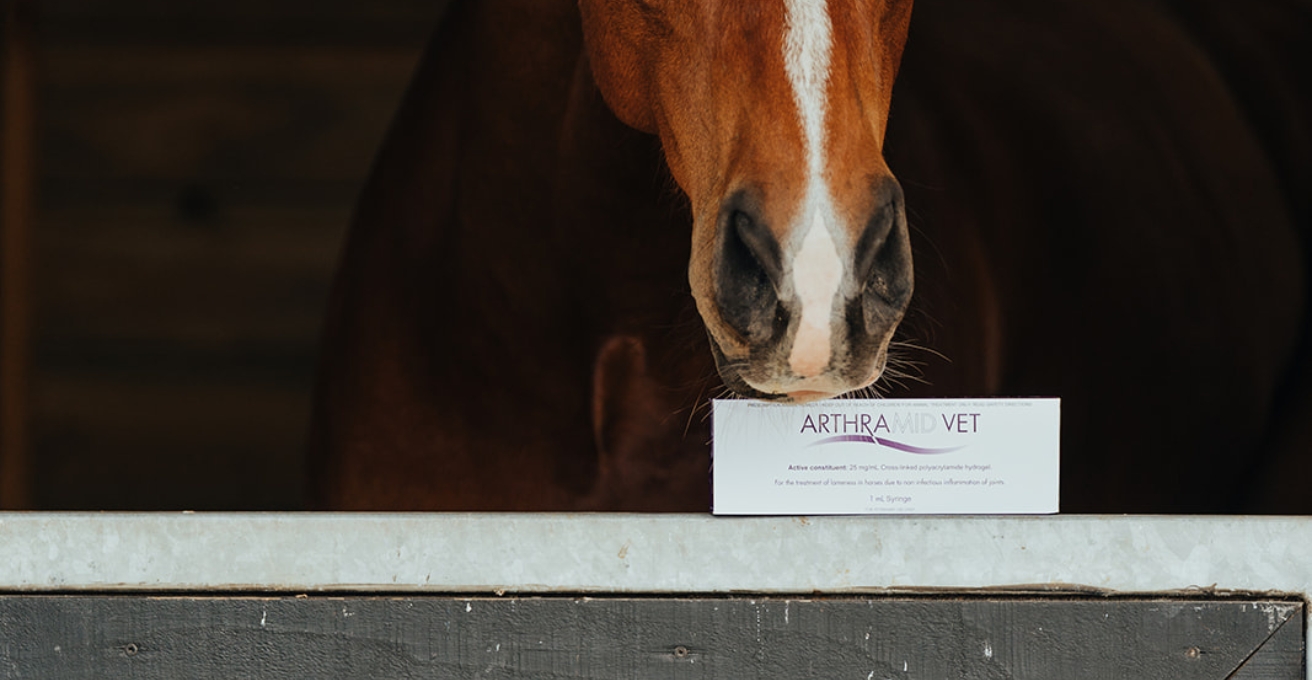
| 2.5% iPAAG (Arthramid) | Integrates into the synovial membrane and forms a biostable scaffold that restores the mechanics of the joint capsule. Non-pharmaceutical | Often within the first week, building over the following weeks | Up to 24 months in published studies | No with-hold time. | Slower to full effect than a steroid, but one treatment, the longest published duration in the table, and no withhold to plan around |
| Orthobiologics | |||||
| Autologous conditioned serum (commonly known as IRAP) | Blood is drawn from the horse and incubated for 22 to 24 hours to raise interleukin-1 receptor antagonist protein (IRAP), then filtered and injected to block a key inflammatory signal | Over the course of the injections, across weeks | Variable. Promising results reported, but most published studies lack a control group | Autologous blood product. Rules on biologics vary by body. Confirm with NZTR | Not a single visit. Usually a course of injections, commonly three, and that schedule reflects clinical convention |
| Platelet-rich plasma (PRP) | The horse’s own blood is concentrated to increase platelets and their growth factors, then injected | Improvements reported over the first one to three months | Short-term results are consistent. At 12 months, reported return-to-work rates range from 20% to 80%, with little data beyond that | Autologous blood product. Confirm with NZTR | Preparation methods vary widely between systems, which makes results hard to compare. Given as one injection or a short course |
| Mesenchymal stem cells | Cells are harvested from the horse’s bone marrow or fat, cultured in a laboratory, then injected | Weeks | Variable, with most studies reporting significant improvement | Autologous cell product. Confirm with NZTR | The most involved option. Harvest plus several weeks of laboratory culture before the horse can be treated, and the highest cost of the group |
Onset, duration and competition status vary by agent, by joint and by individual horse. Corticosteroid stand-down periods, and the status of autologous blood and cell products, should be confirmed with the relevant governing body before treatment. Orthobiologic evidence is drawn from Nedergaard et al. (2024), a systematic review of 22 clinical studies which did not include iPAAG.
Three things the table cannot tell you.
Corticosteroids remain the most commonly used intra-articular treatment in racing, and for good reason. When you need inflammation down quickly, nothing acts faster. The trade-off is duration and possible side-effects..
Orthobiologics use the horse’s own biology rather than a drug, which is a large part of their appeal. The honest position is that the evidence is promising but not yet settled. A systematic review of 22 clinical studies found PRP showed promising results overall, IRAP showed a promising effect but most studies lacked a control group, and stem cell results varied, though the majority of studies showed significant improvement (Nedergaard et al., 2024). The practical consideration for a training programme is different again: all three require a blood or tissue harvest and laboratory processing before the first injection, IRAP and PRP are usually given as a course rather than a single visit and results on joint biology are transient.
Arthramid sits in a different category. It is not a drug acting on inflammation, it is a hydrogel that integrates into the joint lining. In a double-blinded positive control study of racing Thoroughbreds with middle carpal joint lameness, 83.3% treated with 2.5% iPAAG had resolved at six weeks, against 27.3% for triamcinolone acetonide and 40% for sodium hyaluronate (de Clifford et al., 2021).
Combination protocols also exist, and your vet’s recommendation will account for the joint, the severity, the horse’s treatment history and where you are in the campaign. The table gives you the context to understand that recommendation, not a prescription of your own.
What Happens After the Injection, and What Do You Manage?
Post-injection management is planned, not unpredictable. For Arthramid, the protocol is 48 hours of rest, then a reduced-impact workload for up to two weeks while the gel integrates, followed by a vet review at four to six weeks. Your role is monitoring and holding the modified plan, not clinical intervention.
- Treatment day. Injection administered. Horse returned to the stable.
- First 48 hours. Rest. Check the injection site morning and night for heat, swelling or any change in comfort.
- Days 3 to 14. Reduced-impact work. This is not box rest. Controlled exercise continues and conditioning does not have to stop, it just avoids high-load work. Histology in healthy horses has shown 2.5% iPAAG integrated into the synovial lining by day 14, with no free gel remaining in the joint cavity (Lowe et al., 2024).
- Weeks 2 to 6. Progressive return to full work, guided by your vet.
- Four to six weeks. Follow-up examination to assess the response, with a top-up dose if the response has been partial.
- Six to twelve months. Ongoing monitoring, with a repeat dose at this interval if clinically indicated.
For a real-world benchmark, a retrospective review of 701 Thoroughbred racehorses and 2,312 injections found the mean time from treatment to the horse’s next race start was approximately 40 days (de Clifford et al., 2025).
Mike Moroney of Ballymore Stables treated his stayer Sound after a spring campaign:
“What delighted me the most is that when treated early in the preparation Arthramid maintained his soundness throughout multiple arduous training and racing campaigns and his joints have never looked better.”
Mike Moroney, Ballymore Stables
Planned in from the start, the integration window is not something you have to work around, which is why pre-season is where it fits most cleanly.
Call your vet if you see persistent heat at the injection site beyond a couple of days, significant swelling, or lameness that is worse after the injection than before it. Site reactions are uncommon and usually settle, but they warrant a phone call rather than a wait-and-see.
When Will You See Results, and How Long Do They Last?
Results depend on which product went in. Corticosteroids act within days but the effect is measured in weeks to a few months. Arthramid improves more gradually, often with visible change in the first week and continued progress after that, and the published duration runs considerably longer.
An international multicentre prospective study of 43 horses with osteoarthritis in a single fetlock or carpal joint found 82.5% remained sound at 24 months after a single injection, with no adverse effects reported in treated joints (Tnibar et al., 2015). Soundness built progressively: 60% at one month, 79% at six months, and 82.5% at both twelve and twenty-four months.
Two honest qualifications. Not every horse responds equally, which is exactly why the four to six week review exists. And Arthramid is long-term joint support, not a cure for osteoarthritis. The disease is still there. What changes is how well the joint copes with the work you are asking of it.
How Do You Know If the Injection Has Worked?
The signs are the ones you already watch for daily: stride length, willingness in the work, how the horse comes out the morning after a solid gallop, and whether the original lameness has gone. Subtle improvement shows up in attitude and willingness well before it shows up in a flexion test, which is an advantage a vet visiting fortnightly does not have.
“What sets Arthramid apart from other products on the market is the long-lasting aspect of it. The fact that you don’t really have to worry about it for the next 3-6 months is really attractive to us”
JD Hayes, Racehorse Trainer, (Hayes Racing)
If there is no apparent improvement at the four to six week review, that is information, not failure. Report it back. Your vet can reassess, consider a top-up dose, or look at whether another structure is contributing. Waiting it out is the one option that does not help.
