
Your horse is stiff for the first few minutes of work, shorter on one rein, or simply less willing than usual. When arthritis comes up as a possible cause, most people picture cartilage slowly wearing away, like the tread on a tyre.
That picture is only part of the story. Osteoarthritis in horses affects the whole joint. The joint lining (the synovium), the fluid it helps maintain, the cartilage and the bone beneath it are all involved, and changes in one can drive changes in the others. This article explains what changes inside the joint and why. It does not compare treatments. That conversation belongs with your veterinarian, and it is a better one when you understand what is happening inside the joint.
Key takeaways
- Osteoarthritis affects the entire joint, not only the cartilage.
- Inflammation of the joint lining (synovitis) and changes to the joint environment are important parts of the disease process.
- Joint tissues interact, so inflammation and structural damage can reinforce one another.
- Understanding these changes helps explain why early recognition and veterinary management matter.
What does a healthy horse joint look like inside?
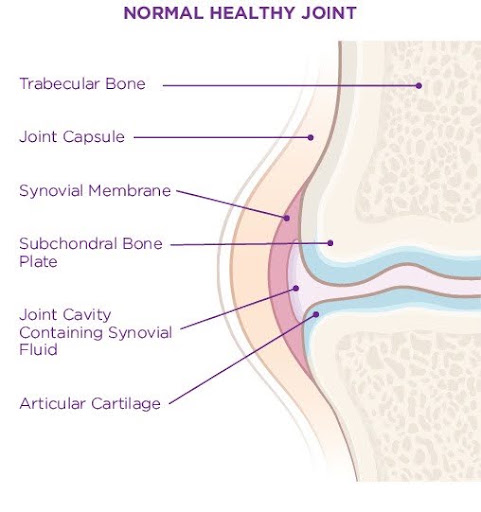
A healthy horse joint relies on several structures working together to give smooth, low-friction movement under load. In a joint such as the fetlock, knee or hock:
- Articular cartilage is the smooth, firm layer covering the ends of the bones. It spreads load and lets the surfaces glide.
- The joint capsule is the tough outer sleeve that encloses and stabilises the joint.
- The synovium, or synovial membrane, lines the inside of the capsule and helps produce and regulate the joint fluid.
- Synovial fluid lubricates the joint and nourishes the cartilage, which has no blood supply of its own.
- Subchondral bone sits beneath the cartilage and absorbs the forces of movement.
Is osteoarthritis in horses simply worn cartilage?
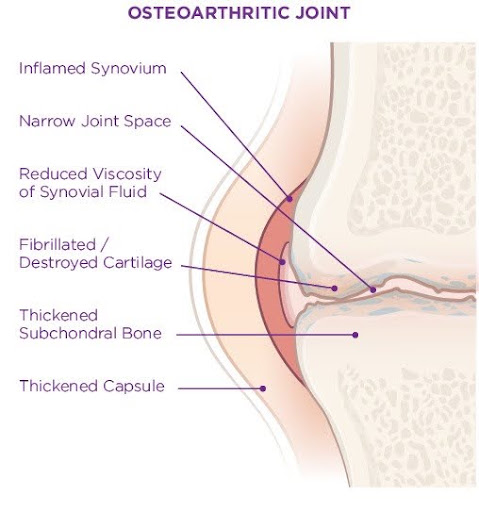
No. Osteoarthritis in horses is a disease of the whole joint, not just cartilage wearing thin. The cartilage, synovium, joint capsule, synovial fluid and subchondral bone can all be affected, and each can contribute to the pain a horse feels.
Osteoarthritis (OA): a progressive disease of the whole joint in which inflammation and structural change affect the cartilage, synovium, joint fluid, joint capsule and underlying bone.
“Wear and tear” suggests a purely mechanical process. In reality, mechanical stress, injury and inflammation interact. Osteoarthritis can follow a single joint injury, years of repetitive loading, conformation that loads a joint unevenly, or defective cartilage such as with developmental orthopaedic diseases like osteochondrosis, and it can affect horses of any age or breed. It does not start the same way in every horse either. In some the earliest changes are in the joint lining, in others the bone or cartilage. Once the process is under way, all of these tissues tend to become involved.
What happens to the synovium when osteoarthritis develops?
The synovium can become inflamed during osteoarthritis, and that inflammation changes the environment inside the joint. This inflammation, called synovitis, is frequently found in arthritic joints and is recognised as an important part of the disease in horses.
The synovium is only a few cell layers thick, but it works like the joint’s lining and housekeeper. It helps control what passes into the joint, produces key components of the joint fluid and clears away debris. When it becomes inflamed, the lining thickens and its cells release inflammatory signalling molecules such as cytokines and prostaglandins. These move through the joint fluid to the cartilage, where they encourage breakdown of the cartilage matrix. The inflamed synovium also releases pain-related messengers, which helps explain why a joint can be sore while structural changes are still mild.
Why does the synovium matter?
When the synovium is healthy, it helps keep the joint fluid, and the cartilage that depends on it, in balance. When it is inflamed, it becomes a source of the signals that drive damage elsewhere in the joint. That is why synovial inflammation is now seen as an active contributor to osteoarthritis rather than simply a side effect of cartilage damage, and why the joint lining deserves as much attention as the cartilage when you and your vet discuss joint health. You can read more about how the joint lining is approached in treatment on our Horse Owners and Trainers page.
What happens to the cartilage and bone?
Osteoarthritis changes both the cartilage covering the joint surfaces and the bone beneath it. The cartilage loses its normal structure, and the underlying bone remodels in response to changing loads.
Under inflammatory signalling and abnormal loading, the matrix that gives cartilage its strength breaks down faster than it can be replaced. Cartilage has very limited ability to repair itself, so over time it can soften, thin and wear through in places. The subchondral bone beneath constantly adapts to the forces it carries, and repeated high loads, such as those in racing and other intensive work, can damage it in ways that contribute to osteoarthritis developing and progressing. Because problems in one affect the other, cartilage and bone are often considered together as a single unit. In long-standing cases, bony spurs called osteophytes can also form at the edges of the joint.
Cartilage itself has no nerves, so damaged cartilage is not the only reason a horse is sore. The synovium, joint capsule and bone all contribute to what the horse feels.
What happens to the synovial fluid inside an arthritic joint?
Osteoarthritis and joint inflammation can change the composition and quality of the synovial fluid, making it less effective as a lubricant.
Healthy joint fluid is thick and slippery, largely because of two naturally occurring substances, hyaluronan (also called hyaluronic acid) and lubricin, which together reduce friction between the joint surfaces. In experimental studies of joint inflammation in horses, hyaluronan concentrations fell, particularly its large, high molecular weight form, and the fluid became less viscous. Lubricin from arthritic horse joints has also been found to differ in structure from lubricin in healthy joints, which may reduce its lubricating ability. Because the synovium helps produce this fluid, an inflamed lining and altered fluid tend to go together. Fluid changes are one part of the process, not its sole cause.
Healthy joint vs osteoarthritic joint
| Joint structure | Healthy joint | Osteoarthritic joint |
| Synovium | Thin lining that helps regulate the joint fluid | Often inflamed and thickened, releasing inflammatory signals |
| Synovial fluid | Thick and slippery, lubricates and nourishes cartilage | Can become thinner, with altered lubricating components |
| Cartilage | Smooth, firm surface that spreads load | Matrix breaks down, softens, thins and may wear through |
| Subchondral bone | Adapts to load and absorbs forces | Remodels, may be damaged by repeated high loads, spurs can form at joint margins |
| Movement and function | Comfortable, free movement through full range | Stiffness, reduced range of motion, altered stride, lameness |
Why can osteoarthritis become a continuing cycle?
Inflammation and tissue damage in the joint can feed each other, which allows osteoarthritis to keep progressing even though what started it may differ from horse to horse.
It is not a neat, numbered sequence, but the pieces commonly interact. Stress or injury triggers changes in the joint. The synovium becomes inflamed and releases signalling molecules into the joint fluid. Those signals, along with changes in fluid quality, promote cartilage breakdown and bone changes. Products of damaged cartilage then stimulate the synovium, prompting further inflammation. Meanwhile, a sore joint changes how a horse moves and loads the limb, adding stress to structures already affected. The original trigger, the joint involved, the horse’s workload and how the joint is managed all influence how quickly this progresses.
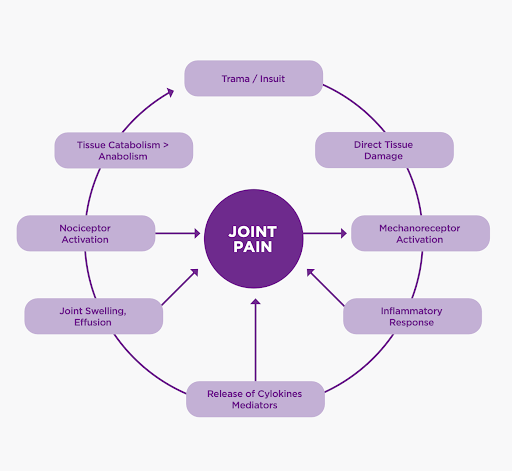
Image adapted from van Weeren P.R, de Grauw J.C. Pain in Osteoarthritis. Vet Clin North Am Eq Pract 26(3), (619-642)
How do these joint changes affect the way a horse moves or performs?
Changes inside the joint can eventually affect comfort, range of motion and willingness to move normally. Osteoarthritis most often shows up as lameness, which may come and go or develop slowly.
In performance horses the early signs are often subtle and easy to put down to attitude or fitness. You might notice stiffness at the start of work that eases as your horse warms up, a shorter or uneven stride, or less willingness on tight turns and in transitions. Some horses become resistant under saddle or less consistent. There may be swelling around a joint, known as joint effusion, or sensitivity when it is flexed. None of these signs is specific to osteoarthritis, and hoof, soft tissue and back problems can look very similar, so any persistent change is worth a veterinary assessment rather than a guess.
Why does understanding the synovium change how we think about osteoarthritis?
Seeing osteoarthritis as a whole-joint process makes the health of the synovium relevant alongside cartilage and bone. Synovial inflammation is part of what drives the disease, not just a symptom of it.
If arthritis is only worn cartilage, it is easy to assume little matters until the damage is advanced. A whole-joint view explains why a joint can be sore with relatively little cartilage change, and why the environment inside the joint deserves attention early. In practice, that means asking your veterinarian to assess small changes in how your horse moves rather than waiting for obvious lameness, and discussing how the whole joint, including its lining, is being managed.
Where does Arthramid fit into this picture?
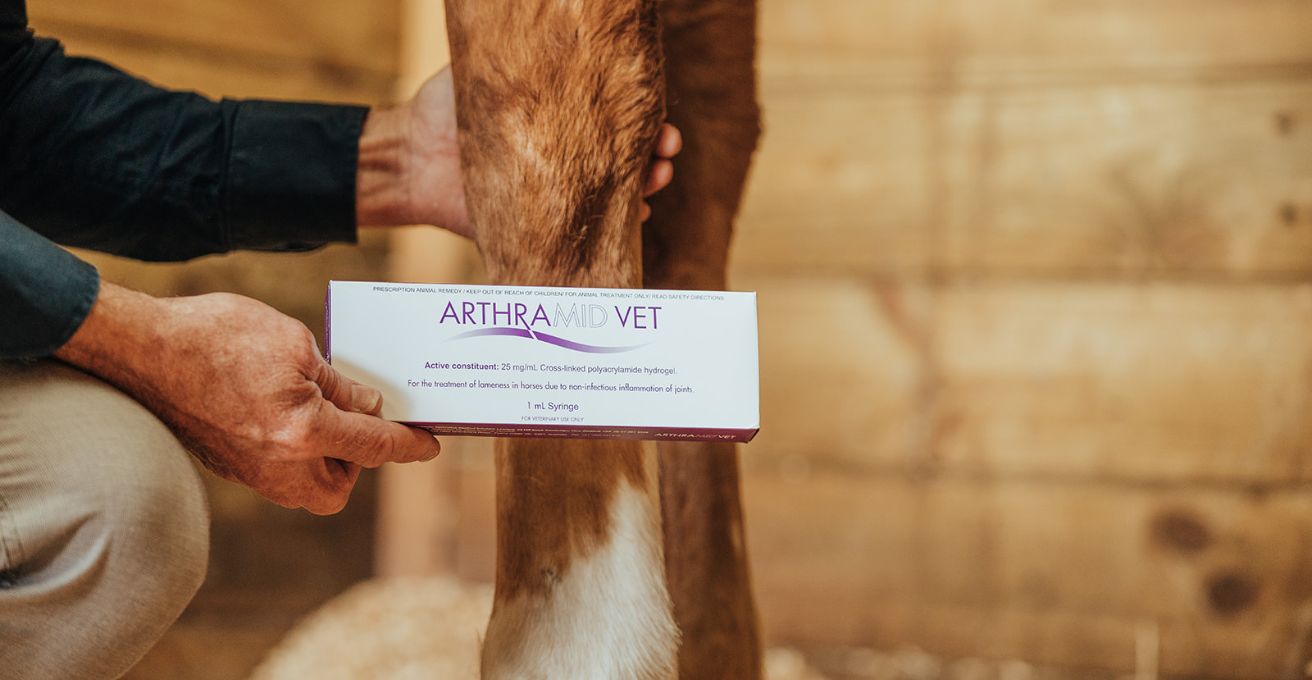
Arthramid is relevant here because it works at the synovial membrane, the joint lining this article has focused on. It is a 2.5% polyacrylamide hydrogel that your veterinarian injects directly into the affected joint.
After injection, Arthramid integrates into the synovial membrane. In a study of treated horse joints, integration was evident by 14 days, and the gel went on to form a stable layer beneath the joint lining that was still present up to two years later. It provides biomechanical support to the synovial membrane and joint capsule. In Australia and New Zealand, Arthramid is registered for the treatment of lameness in horses. Whether it suits your horse depends on the joint, the diagnosis and your horse’s work, and that decision rests with your veterinarian. Arthramid is for use only by veterinarians.
Learn more about how Arthramid works on our Horse Owners and Trainers page, or talk to your veterinarian about your horse’s joint health.
